ROYAL RITUALS OF DEATH
The Curious Traditions of Royal Funerals through the Ages
with Robert Stephenson
On Saturday 8th October 2022 at 3:30 pm
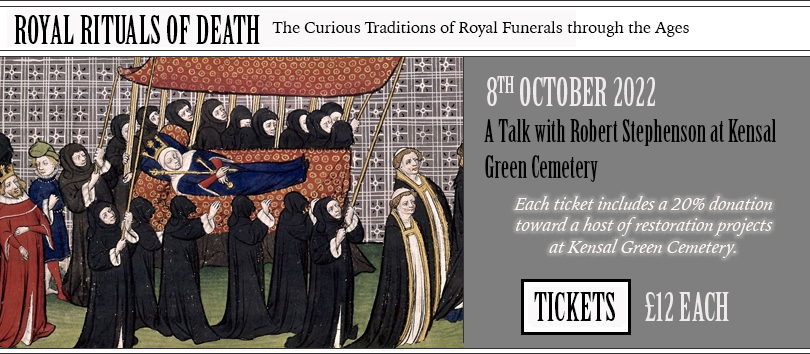
The funeral of Britain’s longest-reigning monarch Queen Elizabeth II on 19th September both broke and adhered to a legacy of royal rituals of death. But what are these traditions and how did they evolve? In this talk, historian Robert Stephenson will offer a comprehensive review of royal funerary practice down the centuries.
Funeral obsequies of a superior kind have always been granted to kings and queens in order to demonstrate that royal power is not diminished by the death of a single monarch. The late sovereign has to be honoured, while facilitating a seamless transfer to the new incumbent. The great panoply of the royal funeral has grown from this necessity.
The mortal remains of monarchs could not be seen to undergo decomposition, so as far back as the medieval period the bodies of kings and queens were embalmed. The corpse was eviscerated and the body cavity filled with sweet smelling herbs, sewn up and then entirely covered in cere cloth, a waxed linen applied hot. The urns containing the viscera could be buried separately. The hearts, especially of queens, were often interred in separate locations dear to the departed. When Eleanor of Castile, the queen of Edward I, died at Harby in Nottinghamshire in 1290 her viscera were interred at Lincoln Cathedral, her heart in Blackfriars Monastery London and her body in Westminster Abbey. James II is an extreme example of this division, technically known as partition, and after his death in exile in Paris in 1688 different parts of his body were deposited in six locations.
Tickets £12 including a 20% donation toward a host of restoration projects at Kensal Green Cemetery.
Robert Stephenson
Robert Stephenson is a qualified City of London Culture and Heritage guide and a trustee at Kensal Green and Brompton cemeteries. He teaches on London and death studies. Robert is also chairman of the National Federation of Cemetery Friends.
Image Credit - A photo of the winged skull made by Dionysus Lazarus taken at the Church of Santa Maria delle Anime del Purgatorio in Arco in Napoli.
|